
What Is Bitcoin?
Bitcoin is a decentralized digital currency created in January 2009. It follows the ideas set out in a white paper by the mysterious and pseudonymous Satoshi Nakamoto. The identity of the person or persons who created the technology is still a mystery. Bitcoin offers the promise of lower transaction fees than traditional online payment mechanisms do, and unlike government-issued currencies, it is operated by a decentralized authority.

Bitcoin is known as a type of cryptocurrency because it uses cryptography to keep it secure. There are no physical bitcoins, only balances kept on a public ledger that everyone has transparent access to (although each record is encrypted). All Bitcoin transactions are verified by a massive amount of computing power via a process known as "mining." Bitcoin is not issued or backed by any banks or governments, nor is individual bitcoins valuable as a commodity. Despite it not being legal tender in most parts of the world, Bitcoin is very popular and has triggered the launch of hundreds of other cryptocurrencies, collectively referred to as altcoins. Bitcoin is commonly abbreviated as BTC when traded.
Who created Bitcoin?
To really grasp how bitcoin works, it helps to start at the beginning. The question of who created bitcoin is a fascinating one because a decade after inventing the technology—and despite a lot of digging by journalists and members of the crypto community—its creator remains anonymous.
The principles behind Bitcoin first appeared in a white paper published online in late 2008 by a person or group going by the name Satoshi Nakamoto.
This paper wasn’t the first idea for digital money-drawing on the fields of cryptography and computer science—in fact, the paper referred to earlier concepts—but it was a uniquely elegant solution to the problem of establishing trust between different online entities, where people may be hidden (like bitcoin’s own creator) by pseudonyms, or physically located on the other side of the planet.
Nakamoto devised a pair of intertwined concepts: the bitcoin private key and the blockchain ledger. When you hold bitcoin, you control it through a private key—a string of randomized numbers and letters that unlocks a virtual vault containing your purchase. Each private key is tracked on the virtual ledger called the blockchain.
How Bitcoin works
Unlike credit card networks like Visa and payment processors like Paypal, bitcoin is not owned by an individual or company. Bitcoin is the world’s first completely open payment network which anyone with an internet connection can participate in. Bitcoin was designed to be used on the internet, and doesn’t depend on banks or private companies to process transactions.
One of the most important elements of Bitcoin is the blockchain, which tracks who owns what, similar to how a bank tracks assets. What sets the Bitcoin blockchain apart from a bank's ledger is that it is decentralized, meaning anyone can view it and no single entity controls it.
Here are some details about how it all works:
Specialized computers are known as ‘mining rigs’ perform the equations required to verify and record a new transaction. In the early days, a typical desktop PC was powerful enough to participate, which allowed pretty much anyone who was curious to try their hand at mining. These days the computers required are massive, specialized, and often owned by businesses or large numbers of individuals pooling their resources. (In October 2019, it required 12 trillion times more computing power to mine one bitcoin than it did when Nakamoto mined the first blocks in January 2009.)
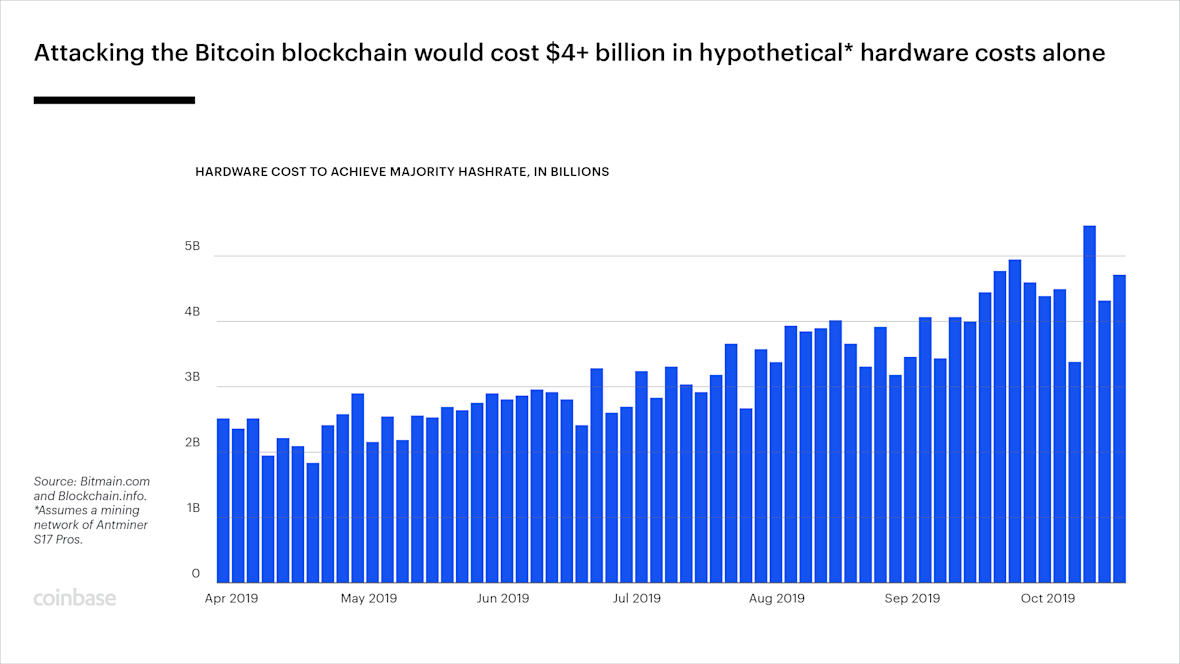
The miners’ collective computing power is used to ensure the accuracy of the ever-growing ledger. Bitcoin is inextricably tied to the blockchain; each new bitcoin is recorded on it, as is each subsequent transaction with all existing coins.
How does the network motivate miners to participate in the constant, essential work of maintaining the blockchain—verifying transactions? The Bitcoin network holds a continuous lottery in which all the mining rigs around the world race to be the first to solve a math problem. Every 10 min or so, a winner is found, and the winner updates the Bitcoin ledger with new valid transactions. The prize changes over time, but as of early 2020, each winner of this raffle was awarded 12.5 bitcoin.
At the beginning, a bitcoin was technically worthless. As of the end of 2019, it was trading at around $7,500. As bitcoin’s value has risen, its easy divisibility (the ability to buy a small fraction of one bitcoin) has become a key attribute. One bitcoin is currently divisible to eight decimal places (100 millionths of one bitcoin); the bitcoin community refers to the smallest unit as a ‘Satoshi.’


.png)



0 Comments