
What is Perception? Meaning, Definition, Nature, Factors Influence, Importance
What is Perception?
Perception is defined as the process by which an individual selects, organizes, and interprets stimuli into a meaningful and coherent picture of the world.
It is a cognitive process by which people attend to incoming stimuli, organize and interpret such stimuli into behaviour.
Perception Meaning
The word Perception comes from the Latin word, “perception” meaning “receiving, collecting, the action of taking possession, apprehension with the mind or senses”.
Perception Definition
a process by which individuals organize and interpret their sensory impressions in order to give meaning to their environment
Stephen P. Robbins
Nature of perception
- Perception is the process by which an individual gives meaning to the environment.
- People‘s actions, emotions, thoughts, and feelings are triggered by their perceptions of their surroundings.
- Perception has been defined in a variety of ways; it basically refers to the manner in which a person experiences the world.
- Perception is an almost automatic process and works in the same way within each individual, yet it typically yields different perceptions.
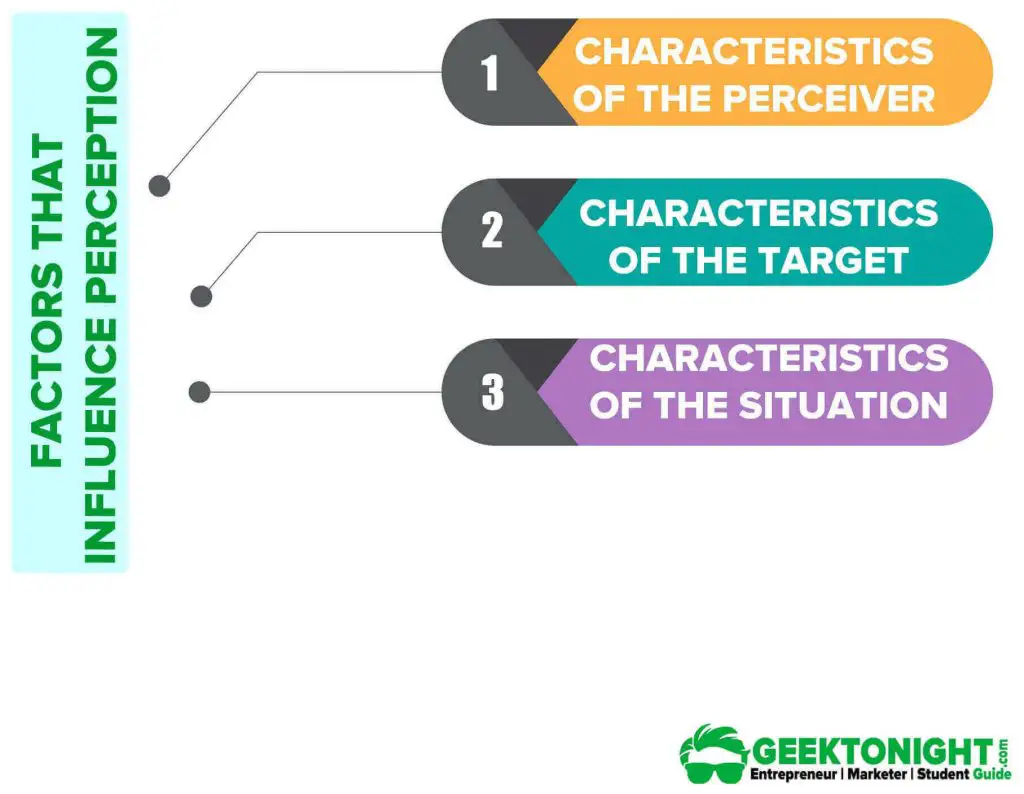
Factors that Influence Perception
- Characteristics of the Perceiver
- Characteristics of the Target
- Characteristics of the Situation
Characteristics of the Perceiver
Several characteristics of the perceiver can affect perception. When an individual looks at a target and attempts to interpret what he or she stands for, that interpretation is heavily influenced by the personal characteristics of the individual perceiver.
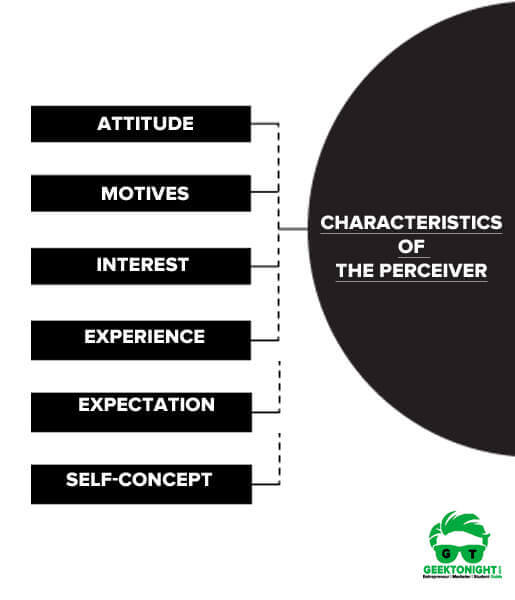
The major characteristics of the perceiver influencing perception are:
- Attitude
- Motives
- Interest
- Experience
- Expectation
- Self-Concept
Attitude
The attitude and aptitude of employees influence perception formation. If they have positive attitudes towards the management, they directly perceive the stimuli given by management. In the case of negative attitudes, the employees suspect the management’s approach. Employees of high aptitude have a desire and attitude for growth. They behave positively toward the management of an organization.
Motives
The motives and desires of employees cause them to view stimuli differently as per their level and angle. Helpful motives of the employees will always assist the management. If they desire to develop themselves and the organization, they will perceive objects and situations positively. Employees having low motives will not work sincerely. The perception will differ depending on different types of motives.
Interest
The interest of individuals draws more attention and recognition to stimuli. Less attention and recognition lowers the impact of stimuli or objects on behaviour. If employees lack interest, behaviour patterns will be less effective, and the perception will be weak.
Experience
The experience of employees results in different levels of perception. A young employee takes time to understand the object and situation. Experienced employees generally understand objects quickly and correctly. However, in contradictory situations, it is difficult to correct aged persons, whereas the young are easily moulded towards achieving the objectives of the organization.
Expectation
Expectations distort perceptions. People see what they expect to see. If they see the object and the situation differently from their expectations, they get frustrated. They are unable to modify their behaviour. The employees may expect more pay and so they perceive the management from that angle. The real stimuli are not properly perceived if expectations exist thereon. The management has to evolve expectations for proper perception.
Self-Concept
Another factor that can affect social perception is the perceivers’ self-concept. An individual with a positive self-concept tends to notice positive attributes in another person. In contrast, a negative self-concept can lead a perceiver to pick out negative traits in another person. A greater understanding of self allows us to have more accurate perceptions of others.

.png)



4 Comments